

Beyond Decarbonization
The hydrogen debate is too often reduced to emission metrics and production costs. The more consequential question is whether decarbonization can be achieved without weakening industrial resilience. Which strategic industries depend on imported fuels and chemicals? How are they exposed to disruption and price shocks? Clean hydrogen can reduce that exposure where direct electrification will not work. Hydrogen’s value therefore extends beyond decarbonization, it is a strategic instrument for protecting industrial capability and national security.
Hydrogen, an opportunity for sovereignty
The real question is not simply how Europe can produce more clean hydrogen, but how it can build an industrial system that remains competitive under pressure and has resilience. That requires decisions across the full value chain, from the source and efficiency of the electron to the reliability, maintainability, and security of the molecule. Projects should be assessed not only by their levelized cost and emissions, but also by the vulnerabilities they remove, the capabilities they retain, and the new dependencies they create. Europe’s chemicals sector shows what is at stake: years of plant closures have weakened interconnected supply chains and contributed to further shutdowns across the industry.
Hydrogen strategic value is greatest where electrification cannot provide the required molecules, reducing agent, or high-temperature conditions. Steelmaking, refining and ammonia are already established demand sectors. With further demand expected from e-fuels for aviation and shipping. This creates a clear basis for prioritization: regulatory and private support should be directed first to applications where clean hydrogen can protect industrial activity that would otherwise struggle to decarbonize or be retained.
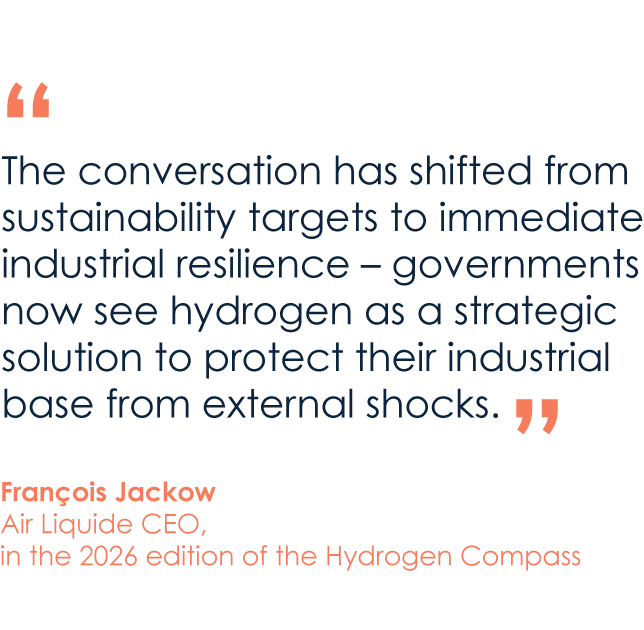
That is the sovereignty argument: a resilient industrial base needs robust access to critical feedstocks, energy, and technical capabilities. Replacing imported fossil inputs with clean hydrogen produced from low-carbon energy can reduce exposure to geopolitical supply disruptions. It can also help retain manufacturing assets, skilled employment and engineering know-how as these are key to secure resilience over the whole plant lifecycle. These outcomes shall not be treated as secondary benefits. They belong alongside emissions reductions and production costs in every assessment of a decarbonization project. Policy support has a clear role: bridge the initial cost gap, help industry scale, and give the supply chain time to mature and reach a sustainable economic footing.
Resetting the reference price, the volatility of grey hydrogen
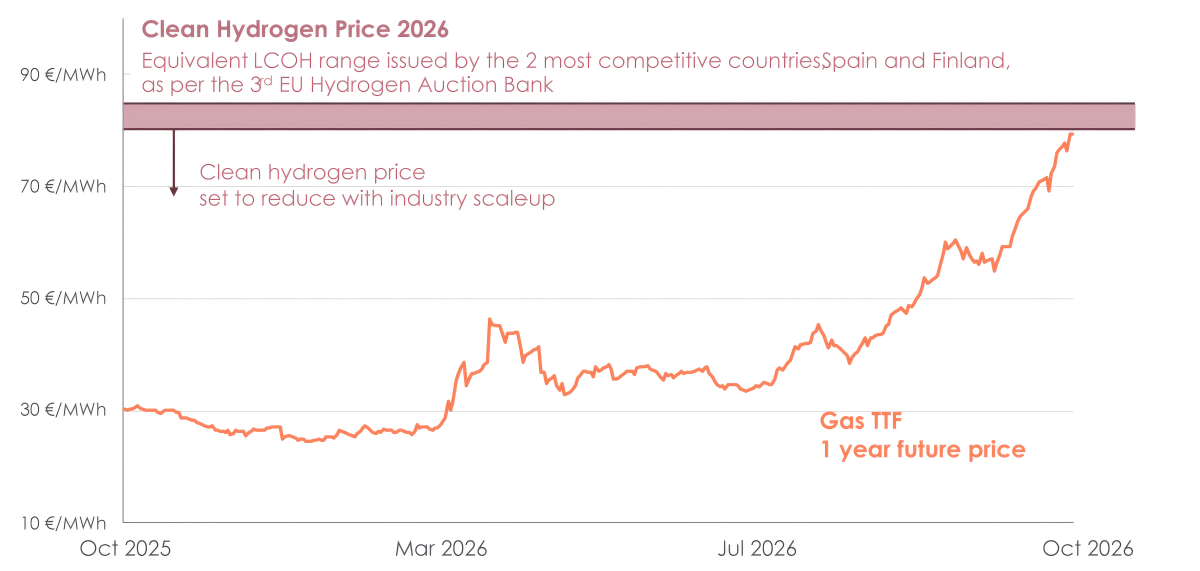
The conventional benchmark for clean hydrogen produced from natural gas without abatement is often presented as a stable historical cost. It is not. Its cost moves with natural gas prices and, in Europe, with the cost of carbon. Treating a favorable point-in-time price as the reference case therefore understates the volatility and exposure that industrial buyers carry over the life of an asset.
If we look at European natural gas prices, since 2021, they have traded in a much higher price range, reaching over 100 €/MWh on the spot market and above 78 €/MWh for 1-year-future option. This latest price puts grey hydrogen at around 5.2 €/kg1. Compared with an electrolytic hydrogen around 5-7 €/kg2, the “clean premium” is substantially narrowing down in Europe. This gap is set to narrow further as electrolyzer demand grows, investment scales up, and higher volumes drive costs down. Coupled with rising carbon-pricing pressure on fossil-based alternatives, these cost reductions could bring clean hydrogen to cost parity and even make it the more competitive option.
Industrial buyers are not choosing between one clean hydrogen and one historical grey hydrogen price. They are choosing between two long-term risk profiles. The current crisis and price shock may be temporary, but another disruption is inevitable especially in a warming world; the unknowns are when it will hit, how long it will last, and how much damage it will cause.
Hydrogen can provide a hedge against future fossil-fuel volatility. That risk reduction has strategic and commercial value even when it does not appear in a simple levelized-cost comparison.
Sources : Swiss Federal Office of Energy + EU Commission
Treating electricity as a strategic constraint
Clean hydrogen can reduce exposure to natural gas, but it also shifts part of that dependence onto electricity. Clean hydrogen can only strengthens resilience if sufficient low-carbon power and grid capacity are available at competitive costs.
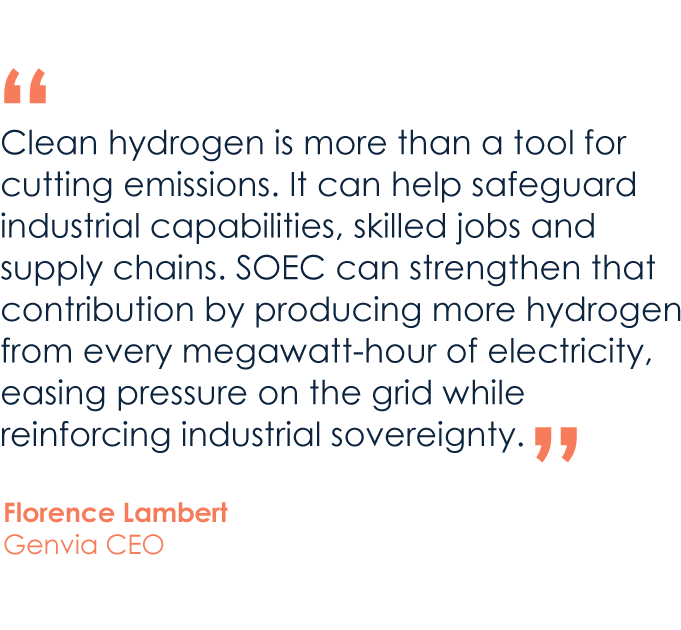
Electricity demand is rising across industry, with data centers adding to the pressure. In the EU, data center consumption is projected to grow from 55 TWh to more than 88 TWh by 2030, accounting for up to a quarter of the increase in electricity demand3. In this context, every megawatt-hour saved can ease pressure on power generation, grids and land use.
SOEC can help adress this strategic constraint by producing more hydrogen from scarce low-carbon electricity. When supplied with heat around 150°C, SOEC systems require less electricity per kilogram of hydrogen than low-temperature technologies such as alkaline and PEM electrolysers. The potential reduction, around 30% or 15 kWh per kilogram of hydrogen, is therefore more than a technology-efficiency gain: SOEC systems preserve limited power, grid capacity and land for other industrial and societal uses.
The potential impact is significant at scale. Take current global hydrogen consumption of 1.2 Mta4. At an electricity saving of 15 kWh per kilogram, switching hydrogen production to SOEC could save around 18TWh of electricity annually. That is equivalent to about 2 GW of continuous power, roughly the output of two world scale nuclear reactors.
Consider a separate case: producing 2.3 Mta of e-SAF, the volume associated with the ReFuelEU 2035 target, would require approximately 1.6 Mta of hydrogen. Similarly, SOEC-driven electricity savings would avoid around 24 TWh per year, equivalent to an average baseload of about 2.8 GW, or approximately 10 GW renewable5. Avoiding that build-out could prevent costs of around 7 billion euros6 while also avoiding the years it can take to bring such new power capacity online and utilizing industrial heat!
Build sovereignty from the electron to the molecule
The sovereignty case extends further upstream, from the hydrogen plant to the electricity that powers it. Under the IEA’s Stated Policies Scenario, global nuclear capacity is projected to grow by about 40% by 2040, while conventional geothermal capacity could rise to roughly 2.6 times its current level over the same period. This expansion points to a larger role for baseload low-carbon power in strengthening national energy resilience. It also creates a new integration opportunity: nuclear and geothermal facilities produce substantial heat that can improve SOEC performance. This could result in a new generation of energy hubs in which SOEC connects two strategic industry pillars: the production of electrons and the production of molecules, whether as standalone hydrogen or of derivatives such as e-SAF and ammonia. In this future, electrolyzers can also become active contributors in the power system: by adjusting their load in response to grid conditions, they can support balancing and stability and eventually should be compensated for bringing such value.
Every major hydrogen infrastructure project should be tested against the resilience of the entire system. The defining question is not simply whether it reduces imported-fuel dependence, but whether it does so without creating a new vulnerability to scarce electricity or to supply chain disruptions. The strongest projects will combine competitive system integration with predictable energy inputs, locally maintainable capabilities, and the agility to respond to supply disruptions. That is the standard by which hydrogen’s contribution to industrial sovereignty should be judged.
Complete the form to download a PDF version of the paper:
References
[1] Methodology for computing SMR-driven LCOH = Natural Gas Feedstock + CAPEX + OPEX + Carbon pricing. Assumptions (IEASource) SMR efficiency 49 kWh/kg H2 HHV. CAPEX 910USD/kWh. OPEX 4.7% CAPEX/year. Carbon pricing = 80EUR/ton. Discount Rate : 8%
[2] Ranges as per 3rd H2 EU Auction Bank for the most competitive countries, in particular Spain at average 5.2 €/kg. Range also confirmed through standard LCOH computation assuming Total Installed CAPEX (stack + BoS + BoP + EPC + Owner’s cost) = 2000-3000 EUR/MW and LCOE = 50-70 EUR/MWh
[3] IEA Key Questions on Energy and AI 2026 : https://www.iea.org/reports/key-questions-on-energy-and-ai
[4] 2026 Hydrogen Compass : https://compass.hydrogencouncil.com/
[5] Based upon IRENA 2025 renewable cost report and assuming a mix of wind capacity 60% and solar capacity 40%: https://www.irena.org/-/media/Files/IRENA/Agency/Publication/2026/Jul/IRENA_TEC_RPGC_2025_Executive_summary_2026.pdf
[6] Based upon IRENA 2025 renewable cost report and assuming a mix of wind capacity 60% and solar capacity 40%: https://www.irena.org/-/media/Files/IRENA/Agency/Publication/2026/Jul/IRENA_TEC_RPGC_2025_Executive_summary_2026.pdf
